AQL Sampling Explained: How to Set Pass/Fail Quality Limits
Published on November 26, 2026
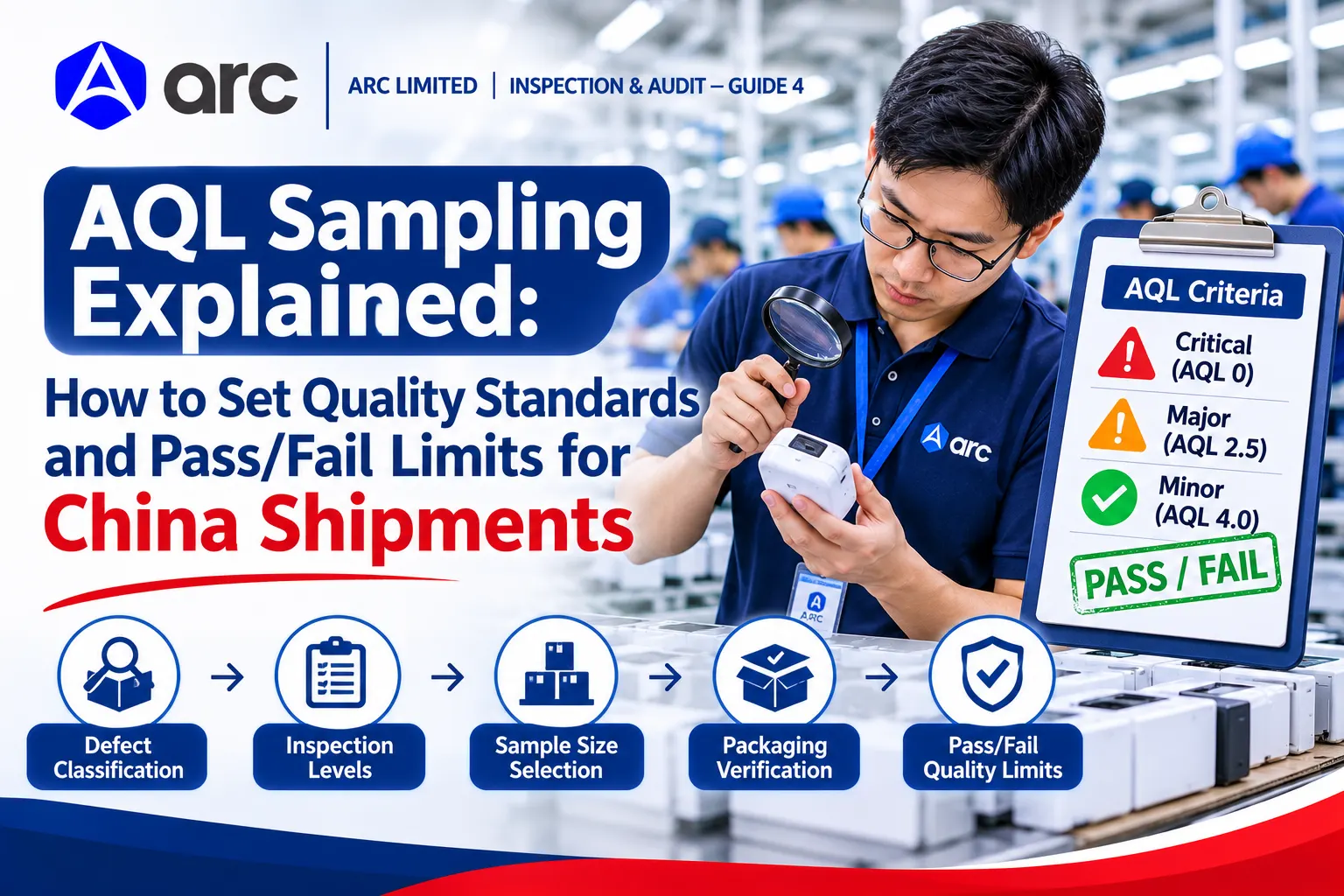
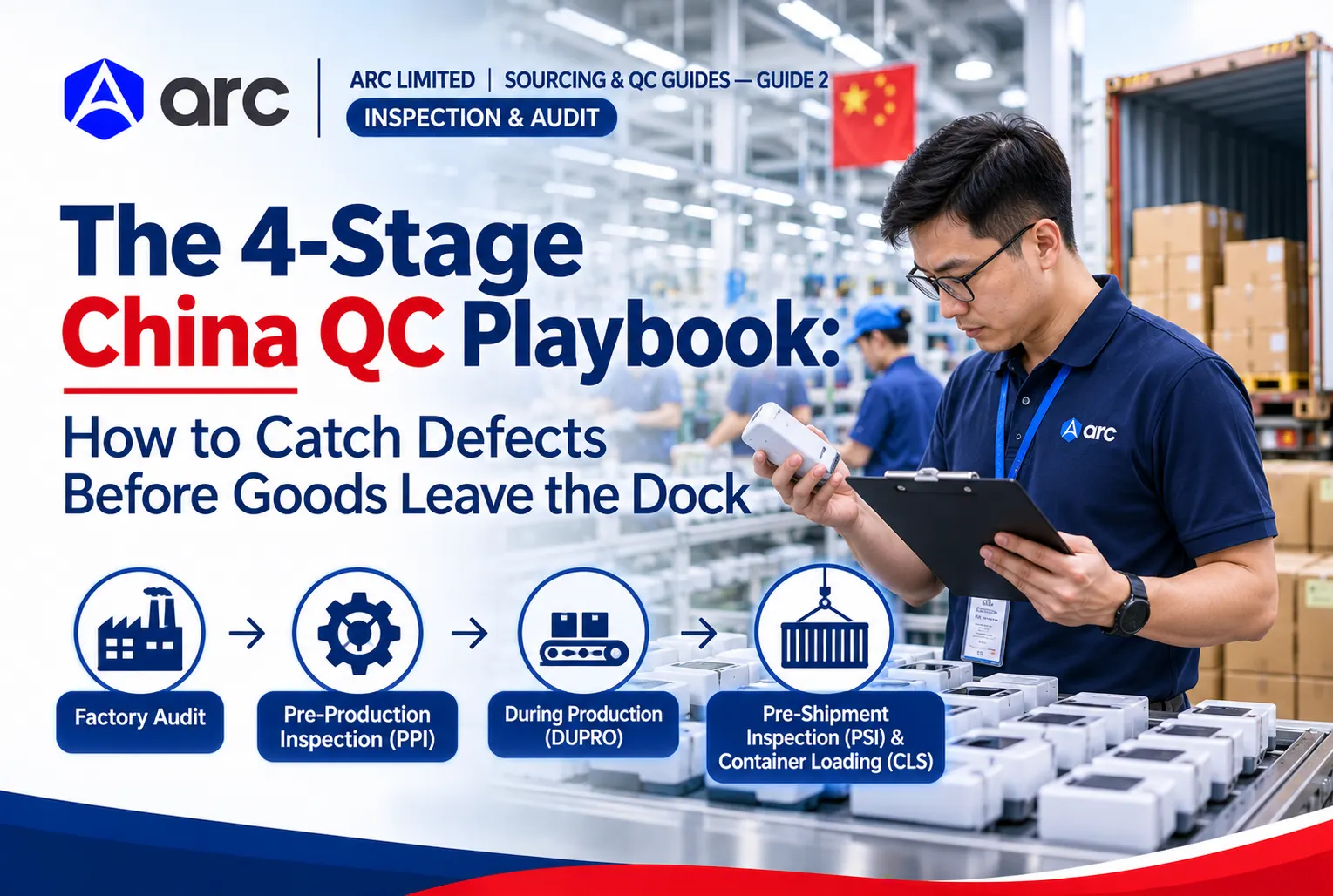
After you have vetted the factory, locked a golden sample, and planned your production stages (Guides 1–3), the final decision is simple: do you release the balance payment or not?
When you order 5,000 units, checking every piece is impossible. Letting the factory show you five hand-picked “good” units proves nothing. AQL (Acceptable Quality Limit) gives you an objective, statistical way to decide pass or fail before the shipment leaves China.
AQL Sampling for China Imports: Defect Classification, Inspection Levels, Sample Size Selection, Packaging Verification & Pass/Fail Quality Limits
1. What Is AQL & Why Does It Matter?
AQL stands for Acceptable Quality Limit. It is an internationally recognized statistical standard (ISO 2859-1 / ANSI ASQ Z1.4) that defines how many units to inspect randomly and how many defects are allowed before the entire lot fails.
Writing clear AQL limits into your Purchase Order removes arguments and forces the factory to take internal quality control seriously.
- Objective Pass / Fail Criteria — eliminates “is this good enough?” debates.
- Fast & Cost-Effective — a trained inspector can properly audit a 5,000-unit order in one day.
- Binding Before Balance Payment — when the PO says “balance released only after passing AQL 0 / 2.5 / 4.0,” factories pay attention.
2. Classifying Defects: Critical, Major & Minor
Not every flaw has the same impact. Defects are grouped into three tiers, each with its own AQL limit:
| Defect Tier | Standard AQL | What It Covers | Real-World Examples |
| Critical Defects | 0 (Zero Tolerance) | Safety hazards, regulatory non-compliance, or anything that can injure a user or cause customs seizure. | Exposed wiring, sharp edges, missing safety marks, wrong voltage, insects/mold in packaging. |
| Major Defects | 2.5 (1.5 for high-end) | Functional failures or obvious visual flaws that make the product unsellable. | Won’t power on, cracked casing, wrong color vs golden sample, missing accessories, failed drop test. |
| Minor Defects | 4.0 (2.5 for luxury) | Slight cosmetic issues that do not affect function or normal saleability. | Tiny scratch on non-visible area, slight glue residue, minor print smudge, slightly crooked sticker. |
Tip: Define these three categories clearly in your Purchase Order (or quality agreement) so there is no dispute during inspection.
3. Choosing Your Inspection Level
Under ISO 2859-1, sample size depends on your order quantity and the Inspection Level you choose:
- General Inspection Level II (Recommended): Used in over 90% of consumer goods and electronics inspections. Best balance of coverage and speed.
- General Inspection Level I (Reduced): Smaller sample. Only for long-term trusted factories or very low-value items.
- General Inspection Level III (Tightened): Larger sample. Use for new factories, high-value products, or after a previous failure.
- Special Levels (S-1 to S-4): Used for destructive or time-consuming tests (drop tests, battery tests, etc.).
4. Quick-Reference AQL Chart (General Inspection Level II)
Standard ISO 2859-1 table showing sample size and Accept / Reject limits (Critical AQL 0 = fail on first defect):
| Order Lot Size | Code Letter | Sample Size | Critical (AQL 0) | Major (AQL 2.5) Accept / Reject |
Minor (AQL 4.0) Accept / Reject |
| 91 – 150 | F | 20 | 0 / 1 | 1 / 2 | 2 / 3 |
| 151 – 280 | G | 32 | 0 / 1 | 2 / 3 | 3 / 4 |
| 281 – 500 | H | 50 | 0 / 1 | 3 / 4 | 5 / 6 |
| 501 – 1,200 | J | 80 | 0 / 1 | 5 / 6 | 7 / 8 |
| 1,201 – 3,200 | K | 125 | 0 / 1 | 7 / 8 | 10 / 11 |
| 3,201 – 10,000 | L | 200 | 0 / 1 | 10 / 11 | 14 / 15 |
| 10,001 – 35,000 | M | 315 | 0 / 1 | 14 / 15 | 21 / 22 |
Worked Example: 2,500-Unit Shipment
- Lot size 2,500 → Code Letter K
- Random sample size = 125 units (pulled from multiple cartons)
- Limits: Critical = 0 allowed | Major = up to 7 allowed (8 = Fail) | Minor = up to 10 allowed (11 = Fail)
- Example result: 0 Critical + 4 Major + 6 Minor = PASS. If Major reaches 8 or more → FAIL (even if others are fine).
5. The 100% Finished / 80% Packed Rule & Packaging Audits
A common factory trick is to call the inspector when only part of the order is finished. ARC only starts Pre-Shipment Inspection when 100% of units are manufactured and at least 80% are packed in export cartons.
Beyond product units, inspectors also verify:
- Random carton selection from top, middle, and bottom of stacks (never factory pre-selected boxes).
- Total carton count against the packing list.
- Barcodes, shipping marks, weights, and dimensions.
- Export carton quality and drop-test readiness where required.