OEM & ODM Sourcing in China: Samples, MOQs & Custom Tooling
Published on November 26, 2026
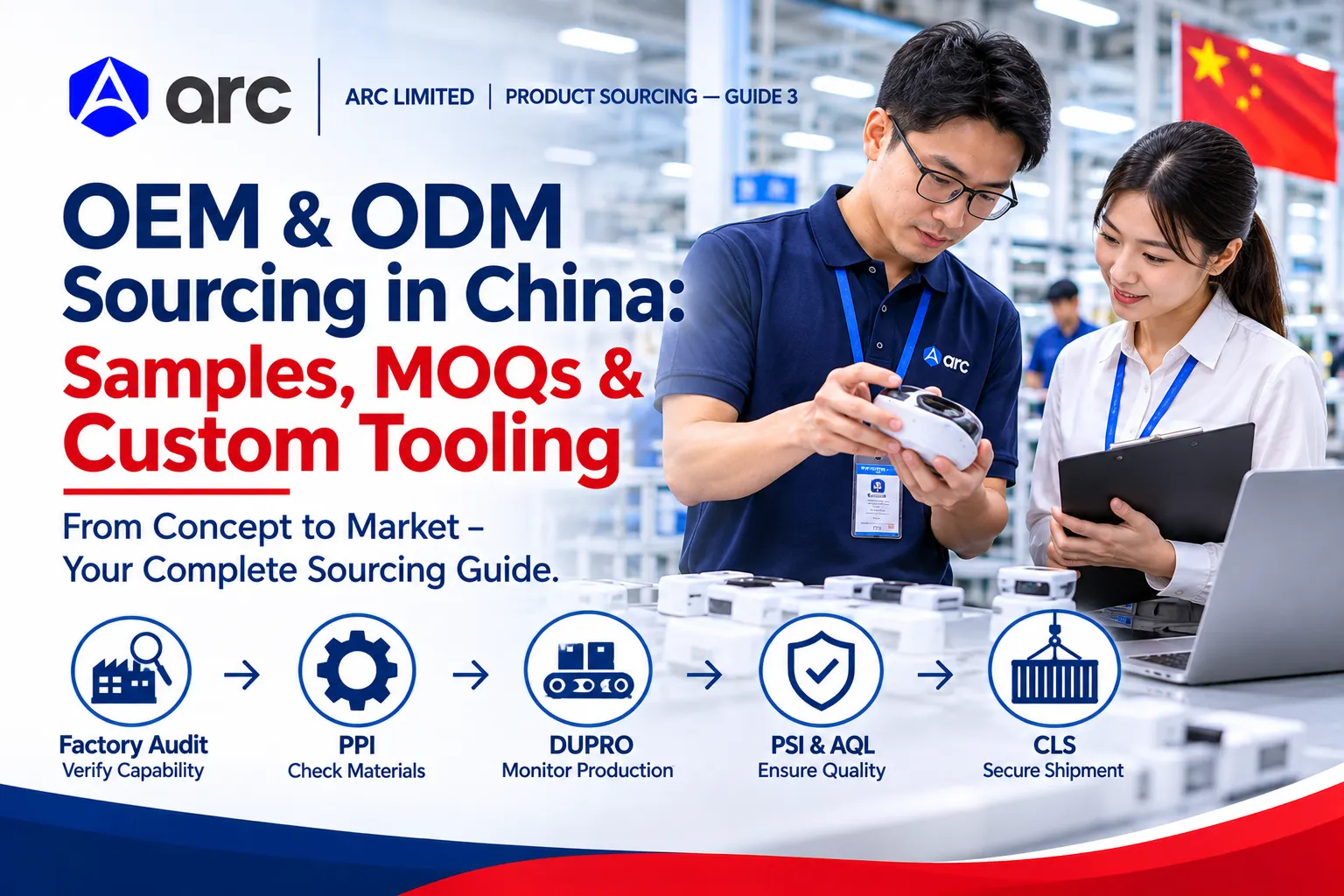
After you have vetted factories and locked quality standards (Guides 1 & 2), the next challenge is launching your own branded or custom product in China.
This is one of the fastest ways to build defensible margins — but it is also where most importers lose money through high Minimum Order Quantities (MOQs), surprise tooling costs, and weak mold ownership. Here’s how to structure OEM and ODM projects properly from initial sample to mass production.
OEM & ODM Sourcing in China: Manufacturing Models, MOQ Negotiation, Custom Tooling, Sample Management & Production Planning
1. Private Label vs. ODM vs. OEM: Choosing the Right Model
Before approaching factories, be clear on how much customization your market actually requires. Over-engineering a first launch can add $10,000+ in tooling fees and 60 days to your timeline when a lighter ODM modification would have achieved the same result.
| Factor | Private Label (Light ODM) | Modified ODM | Full Custom OEM |
| What Changes | Logo, color, retail box & manual on an existing factory design | Existing internal architecture + custom shell, materials, or features | 100% custom product built from your CAD files & BOM |
| Tooling / Mold Cost | $0 (uses factory’s public mold) | $1,500 – $6,000 (partial molds) | $5,000 – $50,000+ (full custom tooling) |
| Typical MOQ | 300 – 1,000 units | 1,000 – 3,000 units | 2,000 – 5,000+ units |
| Sample Lead Time | 7 – 14 days | 20 – 35 days | 45 – 75+ days (including mold making) |
| IP Exclusivity | Low (others can buy base model) | Medium (exclusive housing/finish) | High (you own the design & molds) |
| Best For | Testing demand & fast launches | Differentiating on Amazon / retail | Established brands & industrial specs |
2. How to Negotiate Lower MOQs Without Sacrificing Unit Price
A factory’s MOQ is rarely arbitrary—it is driven by their upstream raw material suppliers (such as minimum fabric rolls, custom-dyed plastics, PCB runs, or printed carton minimums). Pushing a factory below their cost floor without adjusting the structure simply encourages them to substitute cheaper materials.
Use these 4 proven tactics to unlock lower trial MOQs while keeping quality intact:
- Keep Components Standard, Customize the Packaging: If a factory requires 3,000 units for a custom-colored housing, accept their standard black/white housing for the first 500–1,000 units and invest in a custom retail box, insert, and laser-etched logo instead.
- Consolidate SKUs & Materials: Instead of ordering 500 units each across four completely different products, order 2,000 units that share the same core PCB, chassis, or raw material—factories calculate MOQs per material run, not just per finished SKU.
- Offer a Pilot-Order Price Premium: Propose a 5%–10% higher unit price for an initial 300–500 unit market-validation batch, with a written agreement that the unit price drops to the standard tier once you hit 2,000+ units on reorder.
- Leverage Local Representation: Factories are far more flexible on MOQs when an on-ground sourcing partner in Shenzhen or Hong Kong negotiates in Chinese and signals ongoing multi-order volume across their production calendar.
Common Mistake: Accepting a very low MOQ without verifying material quality or written mold ownership. This often leads to substitutions or disputes later.
3. Custom Tooling & Molds: Protecting Your Investment
When your OEM or modified ODM project requires injection molds, die-casting dies, or metal stamping tools, never treat the mold fee as a casual line item on a Proforma Invoice. Without clear written terms, factories frequently claim joint ownership—or use your mold to produce stock for competitors.
5 Essential Clauses for Every China Tooling Agreement
- 100% Buyer Ownership: State explicitly in bilingual (English + Chinese) writing that upon full payment of the tooling fee, the mold is the exclusive property of your company and cannot be used for any third party.
- Permanent Mold Identification: Require the factory to engrave your company name, part number, and “Property of [Your Company]” directly onto the steel mold base—and verify it with photos.
- Steel Grade & Shot Life Guarantee: Specify the mold steel (e.g., P20 for 100,000–300,000 shots vs. H13/S136 hardened steel for 500,000+ shots) and confirm who pays for routine maintenance and wear-and-tear repairs.
- Cavity Count & Cycle Capacity: Confirm whether you are paying for a single-cavity or multi-cavity mold, as this directly controls your future unit price and daily output capacity.
- Right of Removal: Include an unconditional clause allowing you to retrieve and relocate your mold to another factory at any time, provided no undisputed invoices remain unpaid.
Without these clauses: Factories commonly produce your product for other buyers or refuse to release the mold later.
Pro Tip: Use an NNN Agreement Before Sharing CAD Files
Why Western NDAs Fail in China: Standard US/EU/Indian NDAs rarely hold up in Chinese courts and only cover confidentiality.
What to Sign Instead: Use a bilingual Chinese-governed NNN Agreement covering Non-Disclosure, Non-Use (preventing the factory from using your design), and Non-Circumvention—signed and stamped with the factory’s official red company chop (公章).
4. Sample Coordination: Moving from Prototype to Golden Sample
Slow, messy sample rounds are the #1 reason product launches miss seasonal deadlines. Managing revisions remotely across time zones and language barriers often leads to 3–4 rounds of back-and-forth courier fees.
How ARC Limited streamlines sample coordination on the ground in Shenzhen:
- Stage 1 — Pre-Check in Shenzhen First: Before paying $80–$150 to air-courier a sample overseas, our Shenzhen team receives the sample locally, inspects dimensions, finishes, and logo placement against your spec sheet, and sends detailed HD photos/videos. Obvious errors are fixed in 48 hours instead of 3 weeks.
- Stage 2 — Consolidated Sample Dispatch: If you are evaluating 3–4 shortlisted factories, we gather all samples at our Shenzhen office and ship them to you in a single courier parcel—cutting international express costs by up to 60%.
- Stage 3 — T1 / T2 Tooling Samples (for Custom Molds): For molded products, expect a T1 (first trial) sample to check fit and function, followed by a T2 sample with final surface texture, color matching (Pantone code), and packaging.
- Stage 4 — Golden Sample Sign-Off: Once approved, we seal and sign two identical Golden Samples—one for your office and one retained at the factory floor as the binding standard for mass production and Pre-Shipment Inspection (PSI).
5. Typical OEM & ODM Project Timeline (China)
| Project Phase | Key Deliverable | Typical Duration | ARC On-Ground Role |
| 1. Spec & Factory Shortlist | Tech pack, BOM, NNN & 3 itemized quotes | 1 – 2 weeks | Bilingual RFQ & factory vetting |
| 2. Tooling & T1 Sample | Mold fabrication & first trial sample | 3 – 5 weeks | Mold steel audit & local T1 check |
| 3. Revisions & Golden Sample | T2 sample, Pantone match & packaging proof | 1 – 2 weeks | Consolidate & seal Golden Sample |
| 4. Mass Production & DUPRO | Raw material check (PPI) & mid-line QC | 3 – 5 weeks | On-site PPI & DUPRO supervision |
| 5. PSI, Consolidation & Ship | AQL inspection, packing & export dispatch | 1 – 2 weeks | Final AQL report & freight handoff |
Build Your Custom Product in China Without the Friction
From negotiating flexible MOQs and managing custom tooling to checking factory samples locally in Shenzhen before they ever board a plane, ARC Limited gives you bilingual, on-ground control over your entire OEM & ODM roadmap.